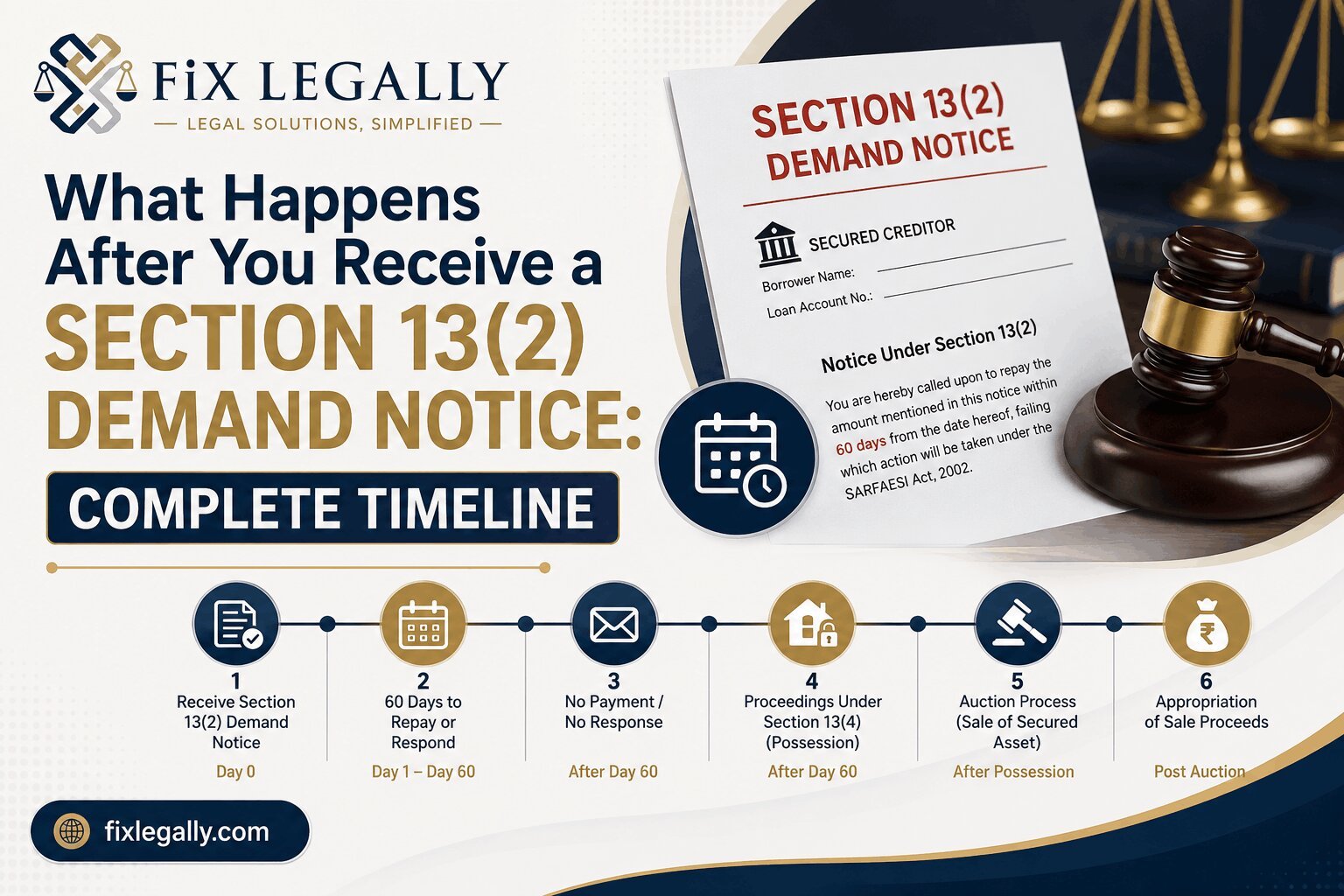
Getting a notice from your bank under Section 13(2) of the SARFAESI Act is scary. Most people read it once, feel their stomach drop, and then have no idea what comes next or how much time they actually have.
Here is the truth: this notice is not the end of the road. It is the start of a legal process that has clear stages, clear deadlines, and clear options for you at every step. If you understand the timeline, you can make much better decisions instead of reacting out of fear.
This article walks you through exactly what happens after a Section 13(2) notice arrives, stage by stage, so you know what to expect and when.
First, What Is a Section 13(2) Notice?
Before this notice can even be sent, your loan account must have been classified as a Non-Performing Asset (NPA). This usually happens when payments are overdue for 90 days. We have written separately about the notice and hearing requirements before an NPA classification, which is worth reading if you are unsure whether your account was classified correctly in the first place.
Once your account is an NPA, the bank issues a Section 13(2) notice. It is a formal demand asking you to pay the full outstanding amount, and it is the bank’s way of saying, “we are starting SARFAESI proceedings against you.”
The Timeline: Day by Day
Let’s break down what actually happens after this notice lands in your hands.
Day 0: The notice is issued The bank sends you a written notice demanding repayment of the entire outstanding loan amount, not just the missed instalments. This is an important point many borrowers miss — the bank can ask for the whole loan, not just what’s overdue.
Day 0 to Day 60: Your response window The law gives you 60 days from the date of the notice to either repay the amount or respond with your objections. This is the single most important window in the entire process, and too many people let it pass without doing anything.
During these 60 days, you can:
- Pay the outstanding amount and close the matter
- Negotiate a settlement or restructuring with the bank
- Send a written reply raising objections to the notice
If you believe the notice has errors, wrong calculations, or was issued without following proper procedure, this is your moment to say so. We have a detailed guide on how to raise an objection to a demand notice that walks through exactly how to do this properly.
The bank’s duty to respond If you send a representation or objection within this window, the bank is legally required to consider it and respond, explaining why they are accepting or rejecting your points. Banks sometimes skip this step or give a vague reply — and when that happens, it can become an important ground later if you need to approach the tribunal.
After Day 60: If nothing is resolved If you have not repaid the amount and the bank is not satisfied with your response (or you didn’t respond at all), the bank can move to the next stage: taking possession of the secured property under Section 13(4).
What Happens at the Possession Stage
Once the 60-day window closes without resolution, the bank can issue a possession notice for the mortgaged property. This is where things get serious, but it still does not mean you have run out of options.
At this stage, the bank may:
- Take physical possession of the property, or
- Take symbolic possession (in some cases, especially for occupied residential property) with the help of the local authorities
If the bank needs help enforcing possession, they can approach the District Magistrate for assistance, which involves its own legal process.
Your Legal Remedy: Section 17 Securitization Application
Here is the part most people don’t know: even after a possession notice, you still have a strong legal remedy available. You can file an application before the Debt Recovery Tribunal (DRT) under Section 17, of SARFAESI Act challenging the bank’s action.
If your matter falls under DRT Delhi’s jurisdiction, our team regularly handles exactly this kind of case — you can read more about our DRT Delhi practice here. We also represent clients before DRT Lucknow and DRT Prayagraj, depending on where your property or loan account is based.
This is a genuine legal check on the bank’s power, and tribunals do set aside actions when banks have not followed the correct process.
What If the Property Goes to Auction?
If the matter is not resolved through the tribunal and the bank proceeds, the next stage is usually an e-auction of the property to recover the loan amount. Even here, procedural mistakes by the bank can sometimes be challenged. Our article on procedural lapses in SARFAESI auctions covers the specific grounds borrowers have successfully used in such situations.
Don’t Forget the Time Limit Works Both Ways
Just as you have deadlines to respond, the bank also has restrictions on how long they can wait before acting, and how the limitation period applies to their recovery action. We explain this fully in our article on the time limit for SARFAESI action, which is useful reading if your loan default happened a long time ago and the bank is only acting now.
Is There a Way to Settle Instead of Fighting?
Yes, and for many borrowers, this is actually the better path. Banks are often open to a One-Time Settlement (OTS), especially if you can show genuine financial hardship along with a workable repayment offer. We’ve covered how this works in our article on One-Time Settlement and loan restructuring. Sometimes a good settlement conversation, started early, can avoid the entire legal process described above.
Quick Timeline Summary
| Stage | What Happens | Your Window to Act |
| Account becomes NPA | 90 days overdue | Before notice is issued |
| Section 13(2) notice issued | Demand for full outstanding amount | 60 days to pay or respond |
| Bank reviews your reply | Bank must respond to objections | Ongoing during 60-day period |
| Section 13(4) possession | Bank takes possession of property | File Section 17 at DRT |
| Section 17 application | Challenge before DRT | As soon as possible |
| Auction stage | Property may be sold | Challenge on procedural grounds |
Common Mistakes Borrowers Make in This Period
- Ignoring the notice completely. Silence does not stop the process; it only removes your chance to object early.
- Missing the 60-day window. This is your strongest opportunity to raise objections while the matter is still fresh.
- Not keeping copies of correspondence. Every letter, email, and reply matters later if you go to the tribunal.
- Assuming settlement isn’t possible. Many borrowers never even ask the bank about an OTS option.
Frequently Asked Questions
Can the bank take possession of my property immediately after sending the notice? No. The bank must wait for the 60-day period to pass and must follow the required procedure before taking possession.
What if I can’t pay the full amount within 60 days? You can still respond with a settlement proposal or objection. Paying in full is not the only option — many cases are resolved through negotiation or a legal challenge to the process.
Does sending a reply guarantee the bank will stop the process? Not automatically. But it creates a formal record, and if the bank ignores valid objections, this can become a strong ground for your Section 17 application later.
How long does the entire process usually take from notice to possession? It varies by case, but the 60-day response window is fixed by law. What happens after that depends on how the bank proceeds and whether you challenge it before the tribunal.
Talk to Us Before Your 60 Days Run Out
If you have received a Section 13(2) notice, the clock is already running. The decisions you make in the first few weeks often shape how the rest of the case goes.
Our team at FixLegally helps borrowers respond to SARFAESI notices, negotiate settlements, and represent clients before DRT Delhi, Lucknow, and Prayagraj. Get in touch with us for a free initial consultation, and we’ll help you understand exactly where you stand.