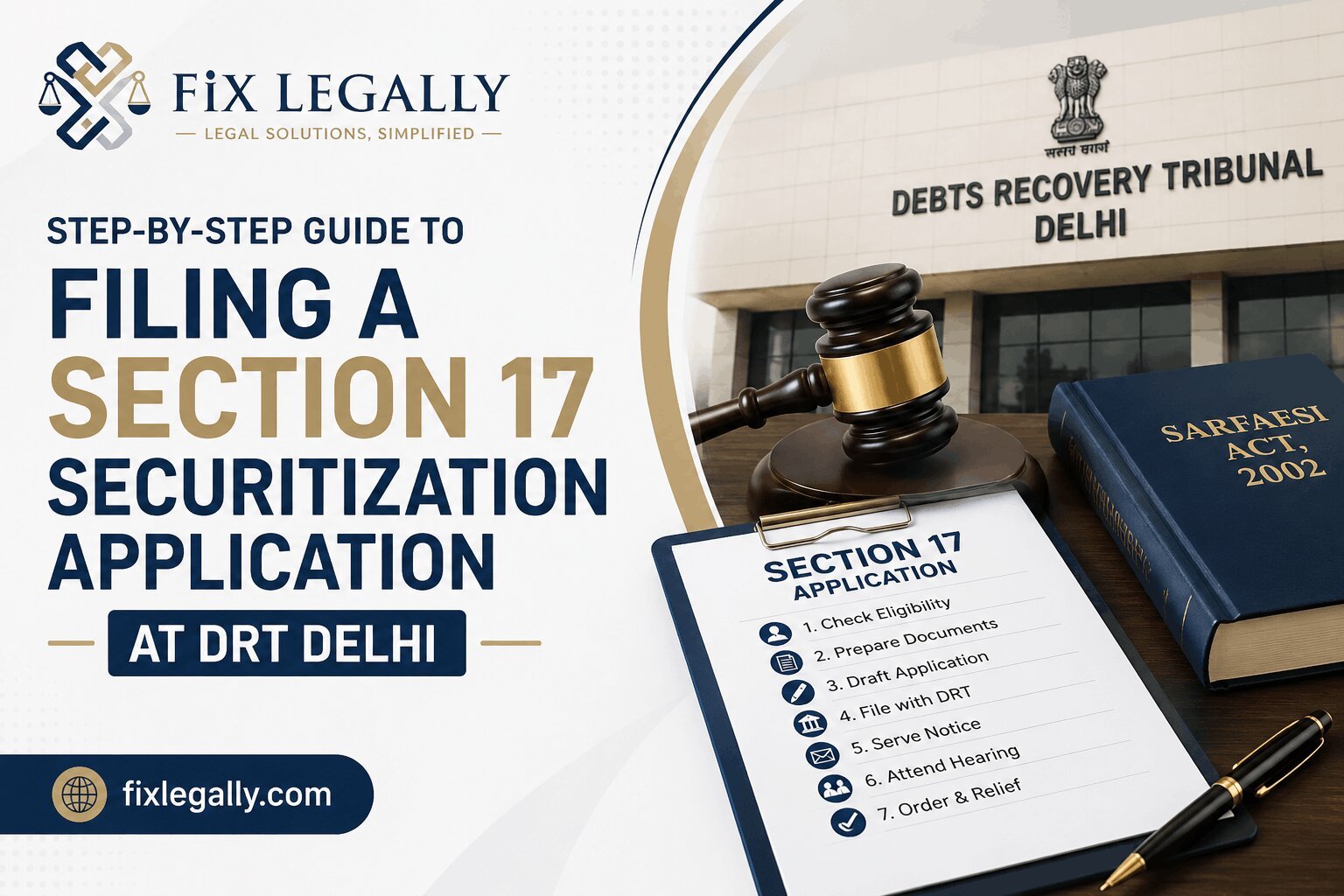
If a bank has sent you a possession notice under the SARFAESI Act, or worse, has already taken physical possession of your property, you still have a legal way to fight back. It is called a Securitization application, and it is filed before the Debt Recovery Tribunal (DRT) under Section 17 of SARFAESI Act, 2002.
Many people panic the moment they see a notice on their door or get a call from the bank. But Section 17 of SARFAESI Act exists for exactly this situation. It gives you, the borrower, a chance to walk into a tribunal and say — “wait, this action was not fair, and here is why.”
In this guide, we will explain what a Section 17 Securitization application is, when you can file it, what documents you need, and how the process actually works at DRT Delhi. We will keep this simple, because you should not need a law degree to understand your own rights.
What is a Section 17 Application?
Section 17 of the SARFAESI Act, 2002 allows a borrower, guarantor, or any person affected by a bank’s recovery action to approach the Debt Recovery Tribunal. This is your main legal remedy once the bank has taken steps like issuing a possession notice under Section 13(4) or moving towards an auction.
Think of it this way: the SARFAESI Act gives banks strong powers to recover their money quickly, without going to a regular civil court. Section 17 is the balance to that power. It is the tribunal’s way of saying, “yes, banks can act fast, but borrowers still get a fair hearing.”
You can file a Section 17 Securitization Application if you believe the bank:
- Give you a demand notice and possession notice
- Classified your loan account as NPA (Non-Performing Asset) wrongly
- Took possession of the wrong property, or more property than needed
- Ignored your reply or objection to the demand notice filed under Section 13(3A) of SARFAESI Act, 2002
- Did not publish the possession notice in newspaper
- Did no affix the possession notice on the outer boundary/wall of the mortgaged property
- Did not serve auction notice as per the procedure and rules
- Went ahead with auction without giving 30 days time
- Bank fixed reserve price of the property without a valid valuation report
If any of this sounds familiar, you already have grounds to explore. We have written in detail about how to raise an objection to a demand notice before this stage — it is worth reading first, since a strong Section 17 case often builds on the objection you already sent the bank.
Who Can File It, and Where?
Any person, including borrower, co-borrower, or guarantor whose property or interest is affected by the bank’s SARFAESI action can file this application. Even a tenant living in the mortgaged property may have grounds to approach the tribunal in certain cases.
The application goes to the DRT that has jurisdiction over the area where the property is located, or where the bank branch that sanctioned the loan operates. For most matters connected to Delhi, this means filing before DRT Delhi.
If your property or bank branch is in Delhi, our team regularly represents clients before DRT Delhi in exactly this kind of matter. You can read more about our DRT Delhi practice here.
Step-by-Step: How the Process Works
Here is what actually happens once you decide to file.
Step 1: Collect your loan and notice documents. Gather your loan agreement, the Section 13(2) demand notice, your reply (if you sent one), the Section 13(4) possession notice, and any bank statements showing your repayment history. The tribunal will want to see the full paper trail.
Step 2: Draft the application. Your lawyer prepares the Section 17 Securitization application, laying out the facts of your case and exactly why the bank’s action should be set aside or corrected. This is not a form you fill in — it needs to explain your specific situation clearly.
Step 3: Pay the tribunal fee. DRT applications require a court fee based on the loan amount involved. Your lawyer can calculate this exactly, since it changes depending on the size of the claim.
Step 4: File before DRT Delhi. The application, along with supporting documents, is filed at the tribunal registry. You will get a case number once it is filed in the registry.
Step 5: Notice to the bank. The tribunal issues a notice to the bank, asking them to respond to your application within 30 days.
Step 6: Hearings begin. Both sides present their arguments. This can involve multiple hearings depending on how complex the matter is and how many issues are being contested.
Step 7: Interim relief, if needed. If your property is at risk of an imminent auction, your lawyer can also apply for a stay order to pause the bank’s action while the tribunal hears the full case. This is often the most urgent part of the process.
Step 8: Final order. The tribunal passes its decision — it may set aside the bank’s action, direct a correction, or in some cases, dismiss the application if it finds the bank’s steps were valid.
Important Deadline You Should Know
There is a limitation period involved in these cases, and missing it can cost you your right to challenge the bank at all. We have covered this in detail in our article on the time limit for SARFAESI action — it is worth understanding both sides of this timeline, since it applies to your response as well as the bank’s action.
What Documents Do You Need?
| Document | Why It Matters |
| Loan agreement | Shows the original terms you agreed to |
| Section 13(2) demand notice | Starting point of the bank’s SARFAESI action |
| Your reply to the notice | Shows you objected within the allowed time |
| Section 13(4) possession notice | The action you are challenging |
| Property documents | Proves ownership or your interest in the property |
| Repayment records | Supports your case on payment history |
A Real-World Example
Suppose a small business owner in Delhi took a loan against his shop, fell behind on payments during a slow year, and received a Section 13(2) notice. He sent a reply explaining his situation, but the bank moved ahead with a possession notice anyway, without addressing his points.
In a case like this, a Securitization application can plead that the bank did not properly consider the borrower’s representation, which is a requirement under the law. Depending on the facts, the tribunal can direct the bank to reconsider the matter, or even set aside the possession action if the procedure was not followed correctly.
Every case is different, and outcomes depend heavily on the specific facts and paperwork, which is why getting the documentation right from day one matters so much.
Common Mistakes Borrowers Make
- Waiting too long to act. The limitation period is real, and delay weakens your case even before it starts.
- Filing without proper documents. An incomplete application gives the bank easy grounds to argue against you.
- Ignoring the possession notice reply stage. What you say (or don’t say) at the Section 13(2) and 13(4) stage often shapes how strong your Section 17 Securitization Application case will be.
- Trying to handle it without legal help. DRT procedure has its own rules and timelines that differ from regular civil courts.
Related Situations You Should Also Know About
If your case also involves possession being taken back after you lost it earlier, our article on Section 14 and lost possession explains how that specific process works. And if the bank has already moved toward an auction, read our piece on procedural lapses in SARFAESI auctions, which covers grounds borrowers commonly use to challenge a sale.
Frequently Asked Questions
Is there a time limit to file a Section 17 Securitization application? Yes. The time period within which the borrower must file a Securitization Application is 45 days, courts generally expect borrowers to act promptly, and any unreasonable delay can weaken your case. It is best to consult a lawyer as soon as you receive a possession notice.
Can I file this application myself, without a lawyer? You are legally allowed to, but DRT procedure, evidence rules, and drafting requirements are technical. Most borrowers find that professional help significantly improves how their case is presented and understood by the tribunal.
What happens if I lose my Section 17 Securitization application? You have the right to appeal before the DRAT (Debt Recovery Appellate Tribunal). This is a separate stage with its own process and pre-deposit requirements.
Does filing a Section 17 Securitization application stop the bank from selling my property immediately? Not automatically. You usually need to specifically request interim relief or a stay order from the tribunal to pause any auction while your case is being heard.
Talk to a DRT Delhi Lawyer Before You Miss Your Window
If you have received a SARFAESI notice or possession notice in Delhi, time matters more than most people realize. The earlier you get proper legal advice, the more options you usually have.
Our team at FixLegally handles Section 17 applications and SARFAESI matters before DRT Delhi regularly, for both individual borrowers and businesses. Get in touch with us for a free initial consultation, and we will walk you through exactly where your case stands and what to do next.